by Ibrahim Ahmad for the Clay-Gilmore Institute for Philosophy, Technology, and Counterinsurgency
The United States government does not officially track who police kill, and this is not an accident of bureaucratic neglect but a condition that has persisted across four decades and multiple administrations, despite the fact that the country maintains detailed federal records on virtually every other significant cause of death. Between 1980 and 2018, the National Vital Statistics System missed 55.5 percent of all police violence deaths, and for Black Americans the miss rate reached 59.5 percent, meaning that nearly three in five Black people killed by police during those forty years were not counted in the official record at all. That absence is where this essay begins, because what follows is not only an argument about racial disparity in American police violence but about why the institution producing that disparity is also the institution charged with recording it, and why the decision not to count is inseparable from the capacity to continue without consequence.
What the data reveals, across more than fifteen thousand documented killings since 2013, is that American policing operates through a threshold for perceived dangerousness that is demonstrably lower for Black and Latino civilians than for white civilians at the same or greater levels of objective threat, that the resulting deaths fall overwhelmingly on men, and that both the legal standard governing use of force and the federal apparatus for recording it are built in ways that make this pattern unreviewable. The claim of this essay is that these are not three problems but one, and that the frame which makes them a single problem is counterinsurgency, a doctrine that sorts populations into those who must be neutralised and those who must be won, that has always performed that sorting along lines of sex, and that requires the sorting to remain unexamined in order to keep claiming it is precise.
I. The raw toll
Mapping Police Violence reports that Black people are 13 percent of the American population and 28.2 percent of those killed by police once cases of unknown race are set aside, which makes Black Americans 2.9 times more likely to be killed than white Americans. Since the database is between 91 and 94 percent male depending on the year, Black men alone account for roughly a quarter of all victims while being about six percent of the country. Latino men account for something close to a fifth. Women of every race together account for between six and nine percent, against a population share of fifty-one percent. White people remain the largest single group of victims in raw numbers while carrying the lowest per-capita risk, which is why the racial claim in this essay rests on rates rather than totals. And Mapping Police Violence codes roughly two percent of victims as transgender, a category the sex-based analysis below does not resolve and should not be read as dismissing.
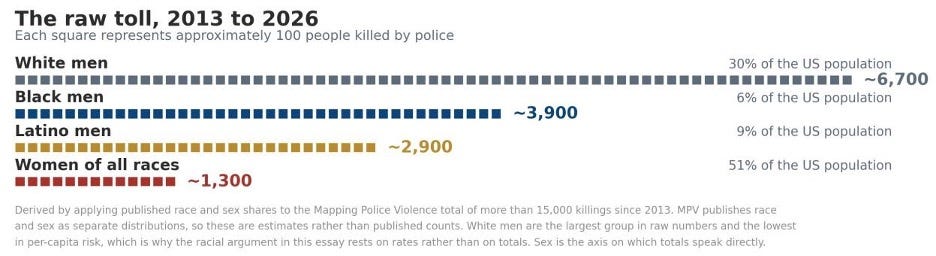
Proportions, however, have a way of flattening what they describe. Mapping Police Violence has now documented more than fifteen thousand killings by police since 2013. Applying the published race and sex shares to that total gives a rough count of around 3,900 Black men killed by American police in thirteen years, against a count for women of every race combined that falls somewhere near 1,300 and is very likely lower. Black men, who are one in sixteen Americans, have been killed at close to three times the raw volume of the entire female population of the United States, which is more than half the country. Add Latino men, at roughly 2,900, and the two groups together account for something in the order of five times the raw death toll borne by all American women of all races. White men, the group with the lowest lifetime risk of any male group, still account for something near 6,700, which is roughly five times the toll borne by all women at once.
Figure 1. Raw death toll by race and sex, 2013 to 2026. Derived figures, see note in chart.
These are derived rather than published counts, since Mapping Police Violence releases race and gender as separate distributions rather than as a joint cross-tabulation, and exact figures would require filtering the incident-level dataset directly, which is the natural next step for this work. But the order of magnitude is not in question, and the direction of any correction would be to make the disparity larger rather than smaller.
Spread across thirteen years, those 3,900 deaths amount to roughly three hundred Black men killed by police every year, or one about every twenty-nine hours. Edwards, Lee, and Esposito translated the same pattern into individual terms in their 2019 analysis in the Proceedings of the National Academy of Sciences, finding a lifetime risk for Black men of 96 per 100,000, or roughly one in every thousand across a life, against 53 per 100,000 for Latino men, 39 for white men, and about one in thirty-three thousand for women of all races. That distance between the two ends of the spectrum is not a margin of difference but an order of magnitude.
What matters most about these figures is what has failed to move them. Police killings in the United States rose almost every year from 2019 through 2024 and then declined in 2025 for the first time in six years, and across that entire span, through a national protest movement, a wave of state-level use-of-force legislation, three presidential administrations, and a measurable change in the overall volume of killing, the racial and sex composition of the victim population barely moved at all. A pattern that survives changes in its own magnitude is not being produced by the conditions that changed. It is being produced by something underneath them.
II. The perception threshold and the law that protects it
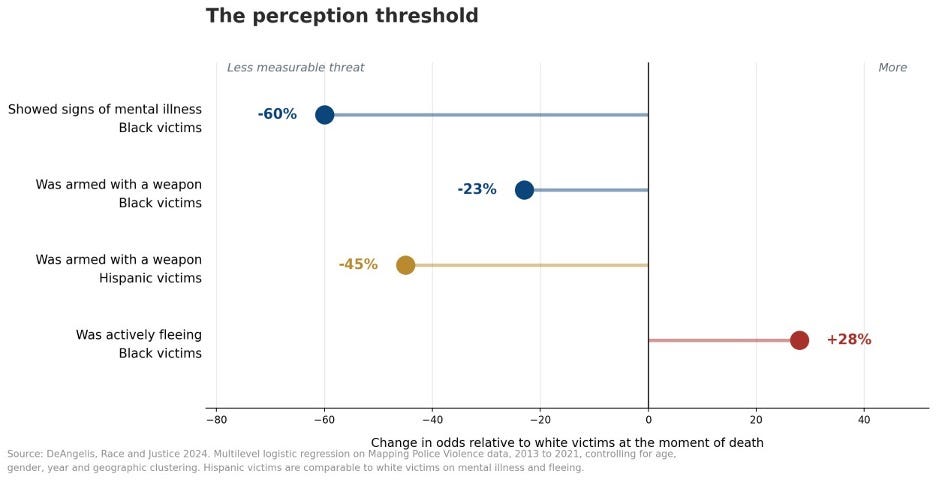
The standard defence of racial disparities in police killings holds that they reflect differential rates of dangerous encounter rather than differential treatment within those encounters, that Black men are killed more often because they are more often in situations involving weapons, resistance, or flight. Reed DeAngelis tested this claim in a 2024 study in Race and Justice, using Mapping Police Violence data from 2013 to 2021 and multilevel logistic regression controlling for age, gender, year of killing, and geographic clustering at the state, ZIP code, and neighbourhood level. What the regression finds is the opposite of what the defence requires. At the moment of death, Black victims had sixty percent lower odds than white victims of showing signs of mental illness and twenty-three percent lower odds of being armed with a weapon, while simultaneously having twenty-eight percent higher odds of actively fleeing. Hispanic victims had forty-five percent lower odds of being armed than white victims and were otherwise comparable to them. The people presenting the least measurable threat at the moment they are killed are, disproportionately, Black and Latino.
Figure 2. Odds at the moment of death relative to white victims, controlling for age, gender, year and geography. Source, DeAngelis, Race and Justice 2024.
What this means is that the racial disparity in who police kill cannot be explained by the racial disparity in how threatening those encounters are. DeAngelis names the finding precisely, concluding that the threshold for being perceived as dangerous enough to kill appears to be higher for white civilians relative to their Black or Hispanic peers. The threshold is not a property of any particular officer or department, since it is stable across a decade of different officers, departments, cities, and political conditions, and it is legible at the population level in regression analysis precisely because it is institutional rather than idiosyncratic.
The more important point is that American law does not merely tolerate this threshold. It makes the threshold the legal test. Since Graham v. Connor in 1989, written by Chief Justice Rehnquist, claims of excessive force have been evaluated under a Fourth Amendment standard of objective reasonableness, and the Court held that reasonableness must be judged from the perspective of a reasonable officer on the scene rather than with the twenty-twenty vision of hindsight, with the officer’s subjective motivation treated as irrelevant. Read alongside the regression, the consequence is stark. The variable the law asks about is whether the officer perceived a threat. The variable DeAngelis measures is that the perception of threat arrives earlier and on thinner evidence when the civilian is Black or Latino. A legal standard that defers to perception cannot detect a bias that operates through perception, because the biased perception is the thing being deferred to.
This is why the accountability figures are better read as an output than as a failure. Mapping Police Violence records that 98.3 percent of killings by police between 2013 and 2020 produced no criminal charge against the officer, and convictions are rarer still. Each of those outcomes is individually defensible under a standard that asks what a reasonable officer would have perceived. Campaign Zero reports that the rate at which officers are charged has nearly doubled since 2020, which is a real change won by sustained pressure, and it is worth holding alongside the fact that the racial and sex composition of the victim population did not move while it happened. Impunity here is not the system breaking down. It is the system returning the answer its own test was built to return, and marginal improvements in charging leave that test untouched.
III. Two axes, not one
It would be easy to read the first two sections as a single claim about Black men, and the reading would be wrong in a way that matters for the argument. The data describes two distinct mechanisms operating at once, and separating them is what makes the pattern intelligible rather than merely shocking.
The first is a question of volume, and it is sex-selective. Between ninety-one and ninety-four percent of the people American police kill are men, a ratio so stable across the entire database that it is usually treated as background noise requiring no comment. It is not an artefact of the recent data either. The same Lancet study that established the undercount also estimated deaths by sex across the full four decades of its analysis and found 30,600 male deaths from police violence between 1980 and 2019 against 1,420 female deaths, a ratio of more than twenty to one that has been published in one of the most heavily cited papers in the field and has attracted almost no comment since. The second is a question of threshold, and it is racial rather than sexual, since it applies to Black women as forcefully as it applies to Black men and by at least one measure more so. The Fatal Interactions with Police Study, led by Odis Johnson at Washington University in St. Louis, examined 1,762 fatal police encounters and found that 57.2 percent of the Black women killed were unarmed, making Black women the only race and sex group in which a majority of those killed were unarmed, against 19.8 percent for white men at the other end of the same distribution. The odds of an unarmed fatality for Black Americans as a whole came out at close to seven to one, and the study attributes that figure primarily to the unarmed status of Black women. Johnson draws the conclusion that matters here, which is that whatever protection being female confers in a police encounter, it is not distributed equally across racial groups. That is the DeAngelis threshold effect appearing in its most extreme measured form, in the group with the smallest raw numbers, and the Say Her Name campaign has been making the qualitative version of the same argument since 2014.
Holding both findings together is what the evidence actually supports. The volume of lethal force is directed at men, and the threshold at which lethal force becomes lawful drops for Black civilians of either sex. Analysis that attends only to the first produces an account in which Black women do not appear, and analysis that attends only to the second cannot explain why the victim population is nine tenths male. The two axes are not merely coexisting either, since Johnson’s finding is precisely that the sex axis and the race axis modify one another. Any adequate theory has to generate both numbers from one mechanism rather than treating either as noise, and that requirement is what the rest of this essay is answering.
IV. Life-years and public health
Before turning to that theory it is worth establishing the scale, because the scale is what disqualifies the usual response. Mapping Police Violence records that the average age of a Black person killed by law enforcement is 33, against 44 for white victims, and those eleven years are not a statistical artefact but a systematic acceleration of death through a specific population. Elizabeth Wrigley-Field quantified the cumulative effect in her 2020 study in Socius, building on the Edwards, Lee, and Esposito demographic model, and calculated that Black men lose 3,772 years of life per 100,000 to police use of force over a lifetime, and 5,696 years per 100,000 once all police encounters are counted, a cumulative loss just over two and a half times that of white men on both measures. Applied to the 284,365 Black male babies born in 2017, and holding current rates constant, that cohort would lose 402 men to police encounters and 16,198 years of life.
To understand what those numbers represent it helps to place them alongside causes of death that receive sustained public health attention, and the Edwards, Lee, and Esposito paper does exactly that. For Black, American Indian and Alaska Native, and Latino men between the ages of twenty and twenty-four, police use of force is the sixth leading cause of death in the United States, trailing only accidents, suicide, homicide by non-police actors, heart disease, and cancer. Every other item on that list has a federal research programme, a dedicated funding stream, and a surveillance infrastructure built to track it. Police violence has none of these, in part because the data infrastructure that would make the comparison visible to policymakers does not exist in any official form, and in part because the framing of police violence as a series of discrete incidents rather than as a cause of death forecloses the public health framework before it can be applied. The numbers warrant that framework. They are simply not allowed to inhabit it.
V. Policing as counterinsurgency
A public health framing tells us what the pattern costs, but it does not tell us what the pattern is for, and the two axes identified above are difficult to derive from any account of policing as bias. Bias predicts a racial gradient and has nothing whatever to say about why nine tenths of the dead are men. The analytical lens of counterinsurgency doctrine would allow us to anticipate both and explain them from a single premise.
Elizabeth Hinton and DeAnza Cook, tracing the criminalisation of Black Americans from the colonial period forward, describe an unbroken line running from antebellum slave patrols charged with insurrection suppression, through Reconstruction-era Black Codes and convict leasing, to the federal War on Crime declared in 1965 and the Law Enforcement Assistance Administration that channelled the equivalent of some twenty-five billion of today’s dollars into local law enforcement, three quarters of it to police operations. What that funding purchased was not simply more police but a different kind of police, equipped with military-grade weapons, helicopters, surveillance technology, and tactical units modelled on the counterinsurgency operations the United States was running abroad at the same moment, with the first SWAT team in the country debuting in 1969 at the Los Angeles headquarters of the Black Panther Party. Stuart Schrader’s account of that period, which Hinton and Cook draw on directly, is that counterinsurgency abroad and policing at home were the same practice under two names, exported and reimported continuously across the Cold War. Nikhil Pal Singh puts the conclusion more bluntly, describing urban policing as “a field of war.”
Adam Jones, writing in the Journal of Genocide Research in 2000, argued that gender-selective mass killing, which he called gendercide, is a recurrent and often defining feature of human conflict extending back to antiquity, and that when it targets men it has attracted almost no scholarly or policy attention, making it in his phrase one of the great “taboo” subjects of the contemporary age. His evidence is a catalogue of the same operation performed across radically different cultures and centuries, from the classical practice of killing male captives and enslaving women, to the Ottoman conscription and elimination of Armenian men in 1915 before the deportation of women and children, to the mass death of Soviet prisoners of war whose treatment supplied the techniques later used in the extermination camps, to Srebrenica in 1995 and Kosovo and East Timor in 1999. Across all of these Jones identifies a single recurring procedure, which is the physical separation of men from women as the prelude to killing the men, and a single recurring logic, which is that the men of a subordinated group are read as the population’s capacity for resistance and are therefore removed pre-emptively rather than in response to anything they have done. His argument is not that this is worse than violence against women but that the maleness of the targets is a fact about the mechanism which serious analysis has to account for rather than assume.
Miron Clay-Gilmore’s recent philosophical thesis – the racism as warfare thesis – increases our conceptual acumen by theorizing the historical constitution of American police agencies as racialized fighting forces and the sex-selective targeting that has guided the application of lethal force among Black and other non-western populations across various geographies. Synthesizing insights from Leonard Harris’s account of racism as necro-being, Social Dominance Theory’s finding that arbitrary-set violence takes the form of low-level warfare against outgroup males, and Tommy Curry’s concept of phallicism, Clay-Gilmore argues that counterinsurgency is the framework through which the management of racialised populations by Western state control agencies should be understood, and that its operational logic is sex-specific by design. Importantly, counterinsurgency does (often) not aim at annihilation. It aims at pacification, which requires sorting a population into the irreconcilable and the reconcilable, killing or detaining the first category while winning the second through services, aid, public works, and propaganda. That sorting has been overwhelmingly gendered since French colonial officers systematised the oil-stain method in the 1830s. David Kilcullen, lead author of the American counterinsurgency field manual used after 2001, states the operating assumption directly, that most insurgent fighters are men, and recommends co-opting women through targeted social and economic programmes on that basis. Laleh Khalili’s survey of confinement in counterinsurgencies arrives at the same rule from the other end, finding that in all counterinsurgencies anywhere, “any male is fair game.” The Bureau of Investigative Journalism’s accounting of American drone strikes in Pakistan between 2004 and 2016 shows what the rule produces once it is automated, with men making up 99.6 percent of those killed where the gender of the victim was known.
Read against that background the two axes stop looking like separate findings.
Counterinsurgency predicts a sex-selective volume of lethal force, because the doctrine identifies the men of the governed population as the insurgent category, and it predicts a racial threshold applying to the whole population, because the doctrine treats that population as terrain to be sorted rather than a public to be served, and everyone in it is subject to the sorting. That is precisely the shape of the data, with a victim population that is nine tenths male and a threshold effect reaching its most extreme measured form among Black women. The domestic history supplies the other half of the oil-stain method as well, since the Great Society programmes, community policing initiatives, and youth violence prevention partnerships arrived in the same neighbourhoods and the same decades as the tactical units. Clay-Gilmore’s contribution is to insist that the brute force and the social development be read as one instrument rather than as a punitive policy failing to be offset by a benevolent one.
What follows practically is a different account of what reform can reach. If police violence is bias, the remedy is training, oversight, and the correction of individual perception. If it is counterinsurgency, then the threshold DeAngelis measured is not a distortion in the officer’s judgement but the correct application of a doctrine that requires a population to be sorted before it can be governed, a doctrine that Graham v. Connor then wrote into constitutional law by making the sorting judgement the measure of its own lawfulness. No amount of training corrects a mechanism that is functioning as designed, and no amount of oversight reaches a standard that defines the mechanism as reasonable.
VI. The refusal to count
Between 1980 and 2018 the National Vital Statistics System failed to record 17,100 deaths attributable to police violence out of an estimated 30,800 total, The undercount was highest for Black Americans, at just under 60 percent of an estimated 9,540 Black deaths, though it is worth being precise about the size of that gap, since the rate for white Americans was 56.1 percent and for Hispanic Americans 50 percent. The record fails everyone, and it fails Black Americans somewhat more. The stronger claim is not that the erasure was racially targeted in its mechanics but that it was total enough, for every group, to prevent the racial pattern in the killings themselves from ever becoming visible in official data. The usual explanation for that gap is administrative, that death certificates are filled out inconsistently and coroners lack a reliable category. The more revealing evidence comes from what happened when the federal government tried to close it deliberately.
The FBI launched the National Use-of-Force Data Collection in January 2019 with the explicit purpose of building a national record, and the programme was voluntary. The Office of
Management and Budget set a condition that data covering sixty percent of sworn officers had to be submitted before any figures could be published. In its first year the collection reached fortyfour percent, in its second fifty-five, and by late 2021 the Government Accountability Office warned that the FBI might never publish any incident data at all and that the collection itself could be discontinued by the end of 2022. The reason recorded in that report is not technical. Departments were reluctant to share sensitive data about their own use of force, and nothing compelled them to. The national record of police violence is missing because the agencies that produce police violence decline to report it, and because the only serious federal remedy was built on a foundation of voluntary compliance by exactly those agencies. What looks from the outside like bureaucratic failure is, on the inside, a functioning arrangement in which the counted party holds the pen.
Set beside the legal standard, the shape of the whole becomes visible. Graham v. Connor makes the officer’s perception the measure of lawfulness, which forecloses review of the individual killing. The absence of a federal record forecloses review of the pattern that the individual killings compose. Each closure is defensible on its own terms and each is presented as a technical constraint rather than a choice, and together they produce a form of violence that cannot be examined at either the scale at which it happens or the scale at which it means anything. A doctrine whose legitimacy rests on the claim that it discriminates with precision between combatants and noncombatants could not survive a public accounting of who it actually kills, and it has not had to attempt one.
The same asymmetry runs through the gender data, where the near-total maleness of the victim population is published, freely available, and almost never analysed, which is precisely the analytical taboo Jones identified twenty-six years ago. Some things go uncounted because no one records them. Others go unexamined although the record is open, and the second silence is the harder one to explain by accident.
What this means for how we understand American policing is that the racialised and gendered pattern of lethal targeting is not a failure waiting to be corrected through better training or improved oversight but a settled arrangement held in place by three institutions at once, the data infrastructure that declines to record it, the constitutional standard that defines it as reasonable, and the military doctrine from which its logic descends. Each has been maintained across four decades and, in the case of the doctrine, considerably longer. Accepting that the pattern is structural rather than incidental is the precondition for any serious account of what it would take to change it, and it is where that conversation has to start.
Sources
Mapping Police Violence (Campaign Zero). About the Data, mappingpoliceviolence.us/aboutthedata. National Trends, mappingpoliceviolence.us/nationaltrends. Raw incident-level dataset, airtable.com/shroOenW19l1m3w0H. Database covers 2013 to present and now includes more than 15,000 killings.
Campaign Zero. Mapping Police Violence, For the First Time in Six Years, Police Violence Declined in 2025. February 2026.
Edwards F, Lee H, Esposito M. Risk of being killed by police use of force in the United States by age, race-ethnicity, and sex. Proc Natl Acad Sci USA. 2019;116(34):16793-16798. DOI 10.1073/pnas.1821204116.
DeAngelis RT. Systemic Racism in Police Killings, New Evidence From the Mapping Police Violence Database, 2013-2021. Race and Justice. 2024;14(3):413-422. DOI 10.1177/21533687211047943.
Wrigley-Field E. Life Years Lost to Police Encounters in the United States. Socius. 2020;6. DOI 10.1177/2378023120948718.
GBD 2019 Police Violence US Subnational Collaborators. Fatal police violence by race and state in the USA, 1980-2019, a network meta-regression. The Lancet. 2021;398(10307):1239-1255.
Graham v. Connor, 490 U.S. 386 (1989).
US Government Accountability Office. Law Enforcement, DOJ Can Improve Publication of Use of Force Data and Reporting of Deaths in Custody. GAO-22-104456, December 2021.
Johnson O Jr, Gilbert K, Ibrahim H. Race, Gender, and the Contexts of Unarmed Fatal Interactions with Police. Fatal Interactions with Police Study, Washington University in St. Louis, 2018.
Crenshaw KW, Ritchie AJ, Anspach R, Gilmer R, Harris L. Say Her Name, Resisting Police Brutality Against Black Women. African American Policy Forum, 2015.
Clay-Gilmore MJ. Notes from Inside the Killing Machine, On Racism, Non-Being, and (Counter-Insurgency) Warfare. Philosophy and Global Affairs. 2026. DOI 10.5840/pga202654107.
Jones A. Gendercide and genocide. Journal of Genocide Research. 2000;2(2):185-211. DOI 10.1080/713677599.
Hinton E, Cook D. The Mass Criminalization of Black Americans, A Historical Overview. Annual Review of Criminology. 2021;4:261-286.
Khalili L. Time in the Shadows, Confinement in Counterinsurgencies. Stanford University Press, 2013.
Kilcullen D. Counterinsurgency. Oxford University Press, 2010.
Schrader S. Badges Without Borders, How Global Counterinsurgency Transformed American Policing. University of California Press, 2019.
Singh NP. Race and America’s Long War. University of California Press, 2017.
Harris L. Necro-Being, in A Philosophy of Struggle, The Leonard Harris Reader. Bloomsbury Academic, 2020.
Curry TJ. Killing Boogeymen, Phallicism and the Misandric Mischaracterizations of Black Males in Theory. Res Philosophica. 2018;95(2):235-272.
Bureau of Investigative Journalism. Naming the Dead, military-age males in US drone strikes. 2019.